
Mistra Biopath Programme Director expert at IPBES meeting on Business and Biodiversity Assessment
Article by Jessica Bergh, Mistra Foundation (www.mistra.org)
Mistra Biopath Programme Director, Susanne Arvidsson, participated as an expert member of the Swedish delegation at the latest IPBES meeting in Manchester. She believes that the adopted report, Business and Biodiversity Assessment, is particularly important as it creates a common knowledge base and language between the political sphere, business and other societal actors.
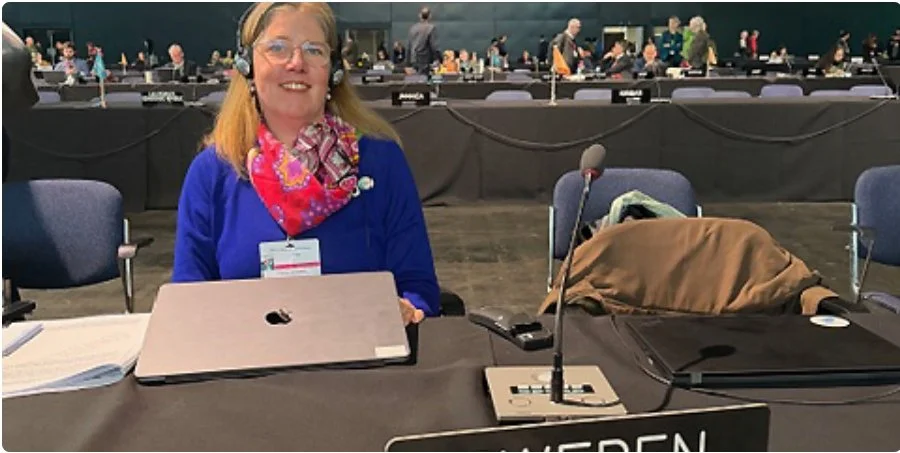
“The takeaway from the meeting for me was the importance of having a common language and legitimacy. IPBES helps create a globally accepted knowledge base that can serve as a reference point for both policy development and strategies for integrating biodiversity into decision-making. This is valuable to Mistra Biopath because it provides an opportunity to position the programme’s research in line with international processes while strengthening the link between Swedish research and global commitments to biodiversity,” says Susanne Arvidsson, senior lecturer at Lund University and programme director of Mistra Biopath.
The most significant outcome of the 12th plenary session of IPBES in Manchester, UK, was the adoption and approval by member countries of the Business and Biodiversity Assessment report. The report has scientific assessments of the impact of businesses on biodiversity and their dependence on it, plus nature’s contribution to society. The report is the result of three years’ work by a wide range of experts.
As an expert member of the Swedish delegation, Arvidsson, programme director of Mistra Biopath and associate professor at Lund University, has contributed scientific and strategic knowledge about the links between biodiversity, business and financial systems.
“In discussions relating to the Summary for Policymakers (SPM), I’ve tried to help ensure that the wording clearly reflects scientific knowledge on the impact of various actors on biodiversity, plus their potential to contribute to solutions. My experience of interdisciplinary and knowledge-integration work at the intersection of research, policy and practice has been particularly relevant in the task of honing messages that are both scientifically robust and useful for decision-makers in politics, business and the financial sector.”
Arvidsson hopes that the summary will be read by plenty of people and that it will lead to policy changes, new business models and strategies that better appreciate natural resources. She sees the results of the meeting and the adoption of the IPBES Business and Biodiversity Assessment as a vital step in the ongoing biodiversity work.
A common language between actors
A particularly important aspect that Arvidsson wants to highlight is how the report creates a common knowledge base and language between politics, business and other societal actors. By linking biodiversity more clearly to economic risks, opportunities and value creation, it helps elevate biodiversity to a strategic decision-making issue at all levels.
“This increases the chances of biodiversity being integrated into legislation, economic instruments, procurement requirements and corporate strategies. The meeting and the adopted summary for decision-makers also provide solid guidance on how this transition can be implemented in practice. For example, there are sections highlighting altered value chains, reduced exploitation of natural resources, better risk management and the development of nature-positive business models. Thus, the report contributes not only to problem formulation but also provides action-orientated knowledge that can be translated into policy and practice. This is vitally important.”
The meeting also confirmed to Arvidsson the relevance of Mistra Biopath’s work, not least the need for knowledge about, and effective solutions for, how political decision-makers, companies and financial actors can better integrate biodiversity into their various decision-making processes. This involves both implementation and actionable knowledge.
“The IPBES process illustrates the power of bringing together research, policy and practice within common frameworks and concepts. The need for learning and capacity building is highlighted as critical to success, something that’s directly relevant to Mistra Biopath and our goals for the research programme.”