
Published: “Landscape perforation in life cycle assessment”
As a postdoc in Mistra BIOPATH Carla R.V. Coelho works on Life Cycle Assessments and Environmental Impact Analysis. In a recent publication she provides new research on “Landscape perforation in life cycle assessment: Method development with global application to quarries and mines”, co-authored with Jan P. Lindner, Ottar Michelsen and Henrik Smith, published in Resources, Environment and Sustainability.
What is the purpose of the paper?
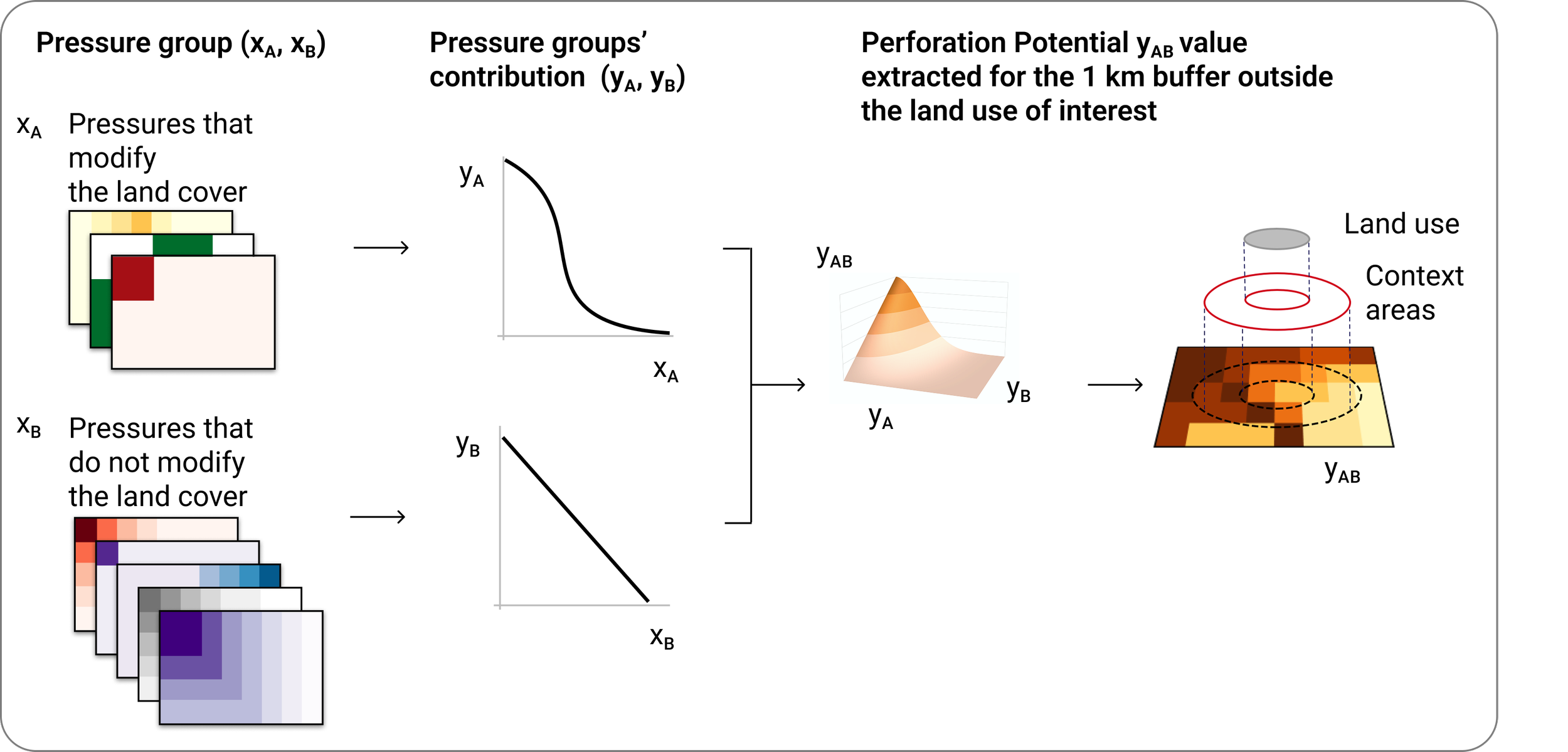
The method presented in the paper is designed for use in life cycle impact assessment to add “what is around the site” context to land-use impacts. In the paper, the authors present a spatially explicit indicator of a land use’s potential to perforate surrounding habitat by combining landscape ecology (perforation/edge effects) with cumulative human-pressure mapping. With this approach, it is possible to judge if a land use (anywhere in the world) is at risk of damaging an otherwise natural or near-natural environment.
How does the paper contribute to halting and reversing biodiversity loss?
Disturbances in otherwise pristine or mostly natural areas are likely to cause disproportionately large ecological effects (edge effects, fragmentation-related impacts on survival, fecundity, movement). The method is developed to flag high-risk locations and supply-chain hotspots before further landscape degradation occurs, therefore halting potential biodiversity loss.
What can financial decision-makers learn from your findings?
Biodiversity impact is not only about the footprint area; location context matters (a site in a low-pressure landscape presents a different risk than the same site in a heavily modified landscape).
It is a practical screening metric that can be integrated into procurement, lending, and investment due diligence to identify nature-related risk concentration in raw-material sourcing (e.g., mining inputs to steel).
Portfolio and supply-chain assessments can move from general “land use” proxies to site-context-sensitive indicators suitable for prioritisation and risk triage.
How can the findings push the transition from knowledge to action?
The method operationalises ecological theory into a computable index (0–1) using widely available spatial layers (Human Footprint components) and a clear workflow (1 km context buffer, separating land-cover-modifying vs non-modifying pressures, and using fuzzy logic). This enables implementation in corporate biodiversity assessments and LCA tools, supporting rapid screening, benchmarking, and targeted mitigation planning.
What are the policy implications of the paper?
The method has potential policy implications, as it is relevant to permitting and biodiversity safeguarding and is essential for sustainable finance and reporting. Environmental assessment and permitting for extraction should require context-sensitive evaluation (recognising higher marginal impacts in intact/low-pressure landscapes).
Biodiversity safeguards can be strengthened by incorporating buffer-based surrounding-pressure metrics in sourcing strategies. For sustainable finance and reporting, the approach supports more rigorous location-based disclosure and risk assessment by linking supply-chain land use to landscape integrity and cumulative pressures.
Link to the publication section:
Carla R.V. Coelho, Jan P. Lindner, Ottar Michelsen, Henrik G. Smith. (2026). Landscape perforation in life cycle assessment: Method development with global application to quarries and mines. Resources, Environment and Sustainability. Volume 23, January 2026, 100293. https://doi.org/10.1016/j.resenv.2026.100293